





GEO vs SEO vs AEO: The New Digital Marketing Strategy Australian Businesses Need in 2026
SEO alone is no longer enough. Learn how GEO, SEO, and AEO work together to help Australian businesses rank in Google, AI Overviews, ChatGPT, Gemini, and future AI-powered search engines.
Digital marketing has changed more in the last two years than it did in the previous decade. For years, businesses focused almost entirely on Search Engine Optimization (SEO) to improve their visibility on Google. Ranking on the first page of search results was often the ultimate goal because it directly influenced traffic, leads, and revenue.
However, the way people search for information is evolving rapidly. Today, users are no longer limited to traditional search engines. Millions of people are turning to AI-powered platforms such as ChatGPT, Google AI Overviews, Gemini, Claude, and Perplexity to find answers, compare services, and make purchasing decisions.
Instead of browsing through multiple websites, users now expect immediate, accurate, and trustworthy answers. This shift has introduced two new optimization strategies alongside traditional SEO: Answer Engine Optimization (AEO) and Generative Engine Optimization (GEO).
For Australian businesses looking to remain competitive in 2026, understanding the relationship between SEO, AEO, and GEO is no longer optional-it is essential.
Why Traditional SEO Alone Is No Longer Enough
SEO remains one of the most effective digital marketing strategies available. Businesses still need to rank on Google because organic search continues to drive significant traffic and revenue.
However, search behaviour has changed dramatically.
A few years ago, a business owner searching for an AI automation provider might type:
"Best AI automation company in Australia"
Today, that same user is increasingly asking ChatGPT:
"Which Australian AI automation companies specialize in migration agencies?"
The difference is significant.
Traditional search delivers a list of websites.
AI-powered search delivers recommendations.
This means businesses must now optimize not only for rankings but also for visibility inside AI-generated answers.
Understanding SEO: The Foundation of Online Visibility
Search Engine Optimization (SEO) is the process of improving a website's visibility within search engine results pages.
The primary objective of SEO is to attract relevant organic traffic by ranking for keywords that potential customers are actively searching for.
A successful SEO strategy includes:
Keyword research
Technical SEO
Content optimization
Internal linking
Backlink acquisition
Local SEO
Core Web Vitals optimization
Google's official recommendations continue to emphasize the importance of creating helpful, people-first content through Google Search Central (https://developers.google.com/search).
While SEO remains the foundation of digital marketing, it now represents only one piece of a much larger visibility strategy.
What Is AEO and Why Is It Becoming Important?
Answer Engine Optimization (AEO) focuses on helping content become the direct answer provided by search engines, voice assistants, and AI-powered answer systems.
Instead of encouraging users to click through multiple search results, answer engines attempt to provide immediate responses.
Examples include:
Google AI Overviews
Google Assistant
Siri
Alexa
Microsoft Copilot
When someone asks:
"What is the best CRM for migration agencies?"
the answer engine attempts to provide a concise response instantly.
AEO helps position your content as that answer.
To succeed with AEO, businesses must create clear explanations, concise definitions, structured FAQs, and schema-enhanced content that answer engines can easily understand and display.
What Is GEO? The Next Evolution of Search Visibility
Generative Engine Optimization (GEO) is one of the most important emerging disciplines in digital marketing.
Unlike SEO, which focuses on ranking webpages, GEO focuses on helping AI systems understand, trust, and reference your brand when generating answers.
Platforms that rely on GEO signals include:
ChatGPT
Gemini
Claude
Perplexity
Google AI Mode
Future AI-powered search platforms
When an AI assistant recommends a company, it relies on trusted sources, authoritative content, strong entity recognition, and topical expertise.
This means businesses must think beyond keywords and focus on becoming recognized authorities within their industries.
For example, if Arthkaira consistently publishes expert content around AI Automation, Migration CRM Development, Workflow Automation, Digital Marketing, and IoT Solutions, AI systems gradually begin associating the brand with those topics.
That association is the ultimate goal of GEO.
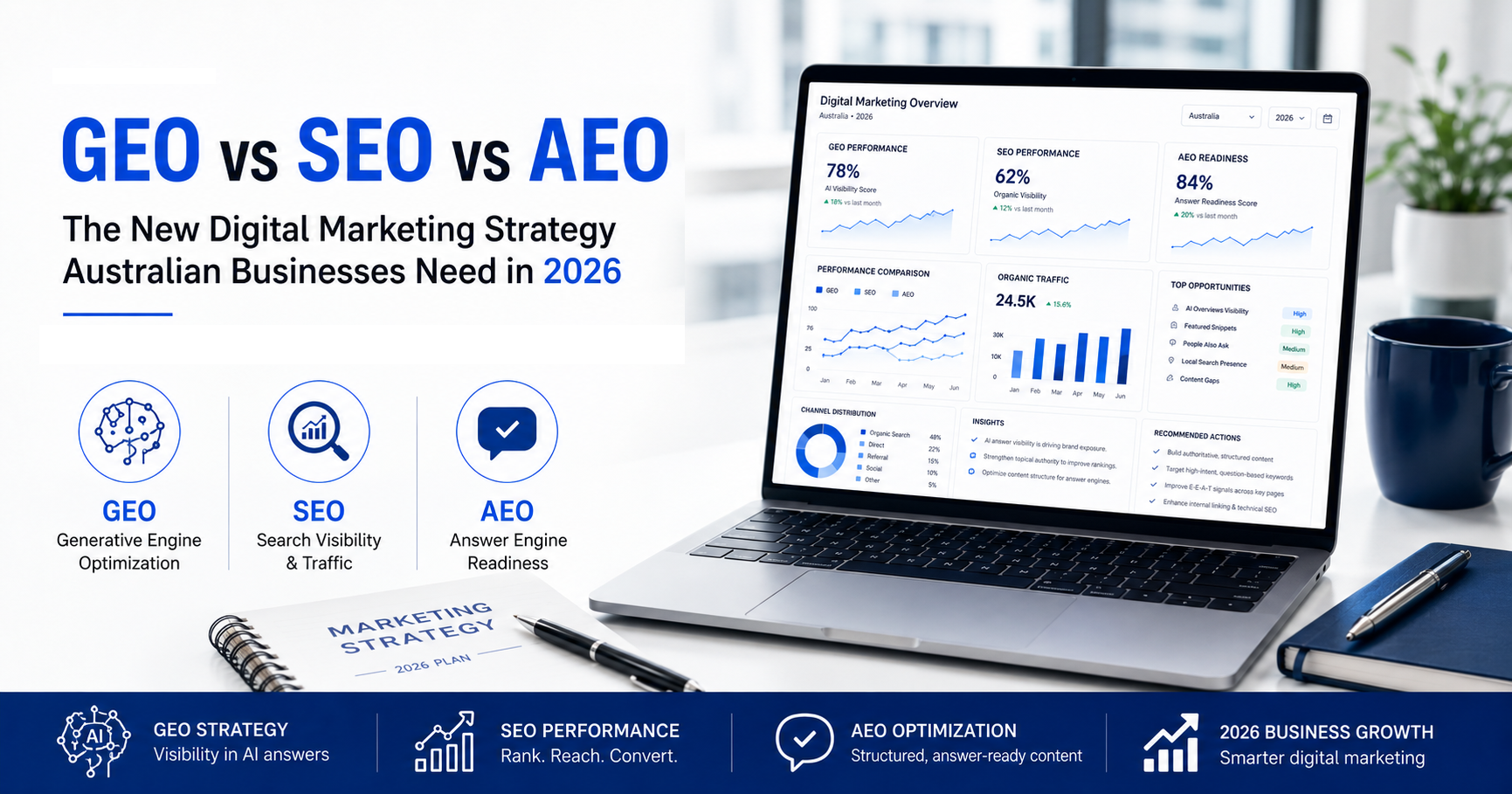
GEO vs SEO vs AEO: Understanding the Differences
Although these strategies are closely related, they serve different purposes.
SEO focuses on helping webpages rank within traditional search results.
AEO focuses on helping content become direct answers within search and voice interfaces.
GEO focuses on helping AI systems reference and recommend brands when generating responses.
The most successful businesses in 2026 will not choose between SEO, AEO, or GEO. Instead, they will build an integrated strategy that combines all three.
Why Australian Businesses Should Invest in GEO, SEO, and AEO Together
Australian businesses are operating in an increasingly competitive digital environment.
Whether you work in migration services, legal consulting, healthcare, real estate, SaaS, or technology, your customers are now using multiple channels to discover solutions.
Some users still search through Google.
Others ask ChatGPT.
Others rely on Google AI Overviews.
Some use voice assistants.
Because customer journeys are becoming fragmented, businesses need visibility wherever decisions are being made.
A company that appears only in Google rankings may lose opportunities to competitors that are also visible within AI-generated recommendations.
How Businesses Can Optimize for GEO in 2026
The most effective GEO strategy begins with building topical authority.
Instead of publishing random content, businesses should create comprehensive content clusters around their core expertise.
For Arthkaira, this means consistently publishing high-quality content around:
AI Automation
Agentic AI
Workflow Automation
Migration CRM Systems
Digital Marketing
IoT Development
Business Process Automation
In addition, businesses should focus on publishing original insights, industry research, case studies, and expert opinions.
AI systems are significantly more likely to reference authoritative content than generic articles that simply repeat existing information.
The Future of Digital Marketing Is Hybrid
The future is not SEO. The future is not AEO. The future is not GEO.
The future is the combination of all three.
Businesses that focus exclusively on rankings may struggle to remain visible as AI-powered search continues to grow.
Similarly, businesses that ignore traditional SEO will still miss valuable organic traffic opportunities.
The smartest strategy is to create content that ranks well on Google, answers questions effectively, and provides enough authority for AI systems to trust and reference it.
Conclusion
Digital marketing is entering a new era.
For years, success was measured by Google rankings alone. Today, visibility extends far beyond traditional search engines.
Businesses must now optimize for search engines, answer engines, and generative AI platforms simultaneously.
SEO helps customers find you.
AEO helps customers get answers from you.
GEO helps AI systems recommend you.
Australian businesses that embrace all three strategies today will be far better positioned to attract traffic, build authority, and generate leads throughout 2026 and beyond.
Frequently Asked Questions
What is GEO in digital marketing?
Generative Engine Optimization (GEO) is the process of optimizing content so AI platforms like ChatGPT, Gemini, Claude, and Google AI Overviews can discover, trust, reference, and recommend your business.
What is the difference between SEO and GEO?
SEO focuses on improving rankings in search engine results, while GEO focuses on helping AI systems cite and recommend your content within generated answers.
What is AEO?
Answer Engine Optimization (AEO) helps content appear as direct answers in search engines, voice assistants, and AI-powered answer systems.
Is SEO dead in 2026?
No. SEO remains important, but businesses must combine SEO with GEO and AEO to maximize visibility across both traditional and AI-powered search environments.
How can businesses rank in ChatGPT?
Businesses can improve visibility in AI systems by publishing authoritative content, building topical expertise, implementing structured data, and creating highly trustworthy resources.
How do you optimize for Google AI Overviews?
Focus on high-quality content, expert insights, concise answers, FAQ sections, schema markup, and strong authority signals.
What industries benefit most from GEO?
Migration agencies, legal firms, healthcare providers, financial services, SaaS companies, technology businesses, and professional service providers can benefit significantly from GEO strategies.
Why is GEO important for Australian businesses?
As AI-powered search adoption grows, GEO helps Australian businesses remain visible when potential customers use AI assistants instead of traditional search engines.