






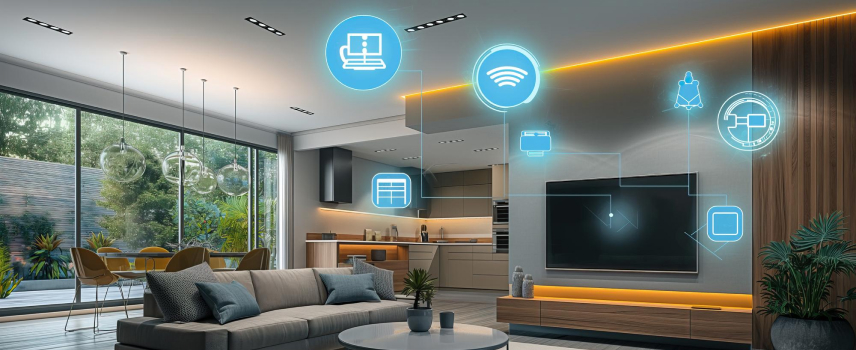
Smart Home & Building Automation
Smart automation should do more than add gadgets to a property. It should make buildings easier to control, more efficient to operate, and more responsive to how people actually use the space.
Arthkaira uses smart home and building automation to connect climate, lighting, access, monitoring, and control into one more manageable environment. We often connect this work with device integration, real-time monitoring, IoT security, and cloud integration so the building performs as one coordinated system instead of isolated smart features.
What Is Included In Our Smart Home & Building Automation Service
Strong automation depends on system logic, device compatibility, control visibility, and practical use cases that improve daily operations instead of creating more complexity.
 Automation strategy aligned to building type, user needs, and operational priorities
- Connected control for lighting, climate, access, and system-wide building functions
- Sensor, dashboard, and alert integration for stronger visibility and remote management
- Energy-efficiency opportunities through schedules, occupancy logic, and smarter control rules
- Platform and device integration planning across existing and new smart infrastructure
- Reporting that focuses on operational control, efficiency, comfort, and long-term system value

Control becomes centralised
Smart automation works best when key systems are visible and manageable through one connected logic layer instead of scattered controls.

Efficiency improves over time
Automated schedules, occupancy logic, and live monitoring can reduce unnecessary energy use and operational waste.

Buildings respond faster
Alerts, remote access, and connected rules help homes and facilities react more quickly to changing conditions and system events.
Automation Performs Best When The Whole IoT Stack Works Together
The strongest smart-property outcomes happen when control systems, monitoring, security, and connected infrastructure support each other instead of operating as separate tools.
 IoT Device Management & Integration
Manage connected devices, communication layers, and system interoperability more reliably.
IoT Device Management & Integration
Manage connected devices, communication layers, and system interoperability more reliably.
 IoT Analytics & Real-time Monitoring
Use dashboards, alerts, and live data to make building performance more visible and actionable.
IoT Analytics & Real-time Monitoring
Use dashboards, alerts, and live data to make building performance more visible and actionable.
 IoT Security & Compliance
Protect connected building systems, access layers, and device networks from avoidable security risk.
IoT Security & Compliance
Protect connected building systems, access layers, and device networks from avoidable security risk.
 Connected Product Development
Extend automation with custom smart interfaces, embedded devices, or control products where needed.
Connected Product Development
Extend automation with custom smart interfaces, embedded devices, or control products where needed.
 Website Development
Build portals or interfaces that make smart-property monitoring and user access easier to manage.
Website Development
Build portals or interfaces that make smart-property monitoring and user access easier to manage.
 Cloud Integration & Migration
Support scalable remote access, central data handling, and cloud-connected building operations.
Cloud Integration & Migration
Support scalable remote access, central data handling, and cloud-connected building operations.
How We Approach Smart Building Control
The goal is not to automate everything for the sake of novelty. It is to improve control, efficiency, comfort, and operational visibility where connected systems can make a measurable difference.
That means we look at building behaviour, user needs, device layers, remote-access expectations, security risk, and how well the systems should coordinate in real conditions. Good building automation is part infrastructure planning, part systems integration, and part operational optimisation.
Our Smart Home & Building Automation Process
Site, system, and use-case assessment
We review the property, control goals, building systems, user journeys, and infrastructure constraints before defining what should be automated first.
Control architecture and integration planning
The devices, sensors, platforms, automations, and dashboard logic are mapped so the solution works as one operational system rather than disconnected smart features.
Implementation, testing, and tuning
Automation rules, remote access, alerts, schedules, and system behaviours are configured and refined so the building responds reliably in real conditions.
Monitoring, optimisation, and scale-up
The solution improves over time by learning from occupancy, usage patterns, energy behaviour, and the operational outcomes that matter most to the property or business.
Smart Automation FAQ
These are common questions property owners and businesses ask before they invest in connected control and automation systems.
Smart home and building automation services usually include connected control for lighting, HVAC, access, sensor data, dashboards, alerts, automation routines, and system integration across multiple devices or building functions.
Yes. Many automation solutions can be adapted to existing homes, offices, and facilities depending on wiring, infrastructure, device compatibility, and the level of retrofit required.
The main benefits often include better operational control, energy efficiency, occupant comfort, remote visibility, faster issue response, and more consistent performance across connected building systems.
Yes. Automated schedules, occupancy-based logic, climate control rules, and live monitoring can reduce unnecessary energy consumption and make resource use more efficient.
Yes. Smart building systems can connect access, alarms, cameras, sensor alerts, and monitoring dashboards so operators or owners can manage these functions more cohesively.
No. Smart automation can work across homes, offices, hospitality environments, shared spaces, commercial buildings, and other facilities where connected control and efficiency are valuable.
Remote management usually happens through connected dashboards, apps, alerts, and control logic that allow administrators or owners to monitor and adjust systems without being physically on site.
Success is measured through system control quality, energy performance, response speed, user comfort, uptime, visibility, and whether the automation delivers practical operational value over time.
