






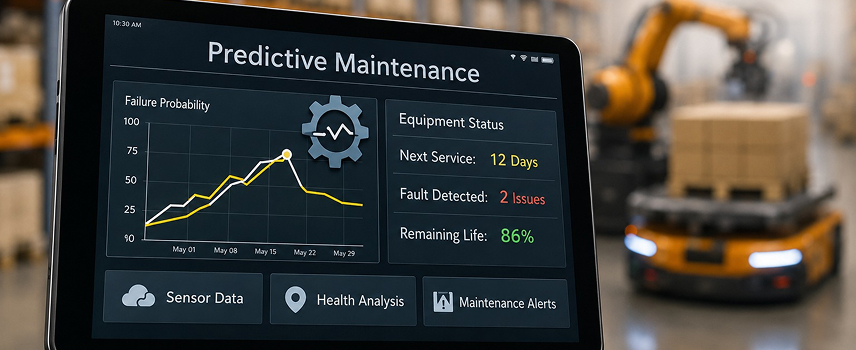
Predictive Maintenance Systems
Maintenance works better when teams can see signs of risk before a failure disrupts operations. Predictive maintenance is about moving from guesswork and surprise breakdowns toward earlier, better-timed intervention based on what connected assets are actually telling you.
Arthkaira uses predictive maintenance systems to turn connected asset data into earlier maintenance visibility, fault warnings, and stronger reliability decisions. We often connect this work with IIoT, IoT analytics, device integration, and IoT security so maintenance intelligence sits inside a more complete connected-operational system.
What Is Included In Our Predictive Maintenance Service
Strong predictive maintenance depends on more than installing sensors. It requires useful condition data, alert logic, maintenance context, and operational workflows that turn warnings into action before failures escalate.
 Condition-monitoring strategy aligned to reliability targets, asset criticality, and downtime risk
- Sensor and telemetry visibility for equipment behaviour, wear patterns, and operational exceptions
- Alerting logic that helps teams act on early warning signs before failures become disruptive
- Asset-health analysis that supports maintenance timing, planning quality, and intervention priorities
- Integration planning across equipment, gateways, dashboards, and maintenance response workflows
- Reporting focused on uptime improvement, fault visibility, maintenance efficiency, and operational value

Failures become easier to anticipate
Predictive maintenance helps teams see warning signals earlier instead of relying only on breakdowns or fixed service intervals.

Maintenance becomes more informed
Connected condition data gives maintenance teams a stronger basis for deciding what needs attention, when, and why.

Downtime pressure can be reduced
The value of predictive maintenance comes from reducing surprises, improving planning, and acting before small issues become expensive interruptions.
Predictive Maintenance Performs Best When Data, Alerts, And Maintenance Logic Work Together
The strongest reliability gains happen when live monitoring, asset context, response workflows, and operational priorities all support the same maintenance decision process.
 Industrial IoT (IIoT) Solutions
Connect production assets, machine data, and operational systems that feed predictive maintenance decisions.
Industrial IoT (IIoT) Solutions
Connect production assets, machine data, and operational systems that feed predictive maintenance decisions.
 IoT Analytics & Real-time Monitoring
Turn live condition signals into dashboards, alerts, and analytical context for earlier intervention.
IoT Analytics & Real-time Monitoring
Turn live condition signals into dashboards, alerts, and analytical context for earlier intervention.
 IoT Device Management & Integration
Keep sensing devices, gateways, and connectivity layers reliable across the maintenance visibility stack.
IoT Device Management & Integration
Keep sensing devices, gateways, and connectivity layers reliable across the maintenance visibility stack.
 IoT Security & Compliance
Protect maintenance data, connected assets, and operational access paths as monitoring expands.
IoT Security & Compliance
Protect maintenance data, connected assets, and operational access paths as monitoring expands.
 Fleet & Asset Tracking
Extend asset visibility into movement, utilisation, and distributed equipment oversight where relevant.
Fleet & Asset Tracking
Extend asset visibility into movement, utilisation, and distributed equipment oversight where relevant.
 Cloud Integration & Migration
Support centralised maintenance dashboards, remote access, and scalable asset-health data handling.
Cloud Integration & Migration
Support centralised maintenance dashboards, remote access, and scalable asset-health data handling.
How We Approach Maintenance Intelligence
The goal is not just to collect asset data. It is to create earlier warning, better intervention timing, and more confidence in which assets need attention before downtime becomes costly.
That means we look at asset behaviour, failure patterns, maintenance priorities, telemetry quality, alert usefulness, and how the maintenance team actually acts on signals in the real world. Good predictive maintenance is part monitoring design, part analytics, and part operational planning.
Our Predictive Maintenance Process
Asset review and failure-risk mapping
We assess the equipment, failure patterns, maintenance history, visibility gaps, and operational criticality before deciding where predictive monitoring should focus first.
Condition-data and alert design
Sensors, telemetry points, thresholds, dashboards, and maintenance response logic are planned so the system surfaces the warning signs that actually matter.
Deployment, validation, and maintenance activation
The connected monitoring setup is implemented, tested, and refined so teams can begin using condition signals in practical maintenance decisions.
Refinement around reliability and planning quality
The system improves over time by learning from asset behaviour, false positives, intervention outcomes, and the reliability gains that matter most operationally.
Predictive Maintenance FAQ
These are common questions businesses ask when they want earlier fault visibility, stronger asset reliability, and better maintenance planning from connected systems.
Predictive maintenance systems usually include condition monitoring, connected sensor data, alerts, trend analysis, asset-health visibility, anomaly detection support, and maintenance workflows designed to identify issues earlier and reduce unplanned downtime.
Predictive maintenance is an approach that uses live or historical equipment data to identify signs of wear, abnormal behaviour, or failure risk before a breakdown creates larger operational disruption.
Reactive maintenance happens after something fails. Predictive maintenance tries to detect warning signs earlier so teams can intervene before failures become more expensive, disruptive, or unsafe.
Yes. In many cases existing assets can be supported through sensors, gateways, integration layers, and monitoring systems that add useful condition visibility without replacing the full equipment base.
Common predictive maintenance data includes vibration, temperature, energy use, pressure, run time, cycle counts, load patterns, error events, and other condition signals relevant to the asset or environment.
Yes. Predictive maintenance can reduce downtime by identifying abnormal conditions earlier, improving maintenance timing, reducing surprise failures, and helping teams respond before issues become critical.
Predictive maintenance relies on IoT analytics and monitoring to surface condition trends, exception patterns, and alerts that indicate when maintenance action should be prioritised.
Success is measured through downtime reduction, maintenance response quality, asset visibility, earlier fault detection, better planning efficiency, and whether the connected maintenance system improves operational reliability over time.
